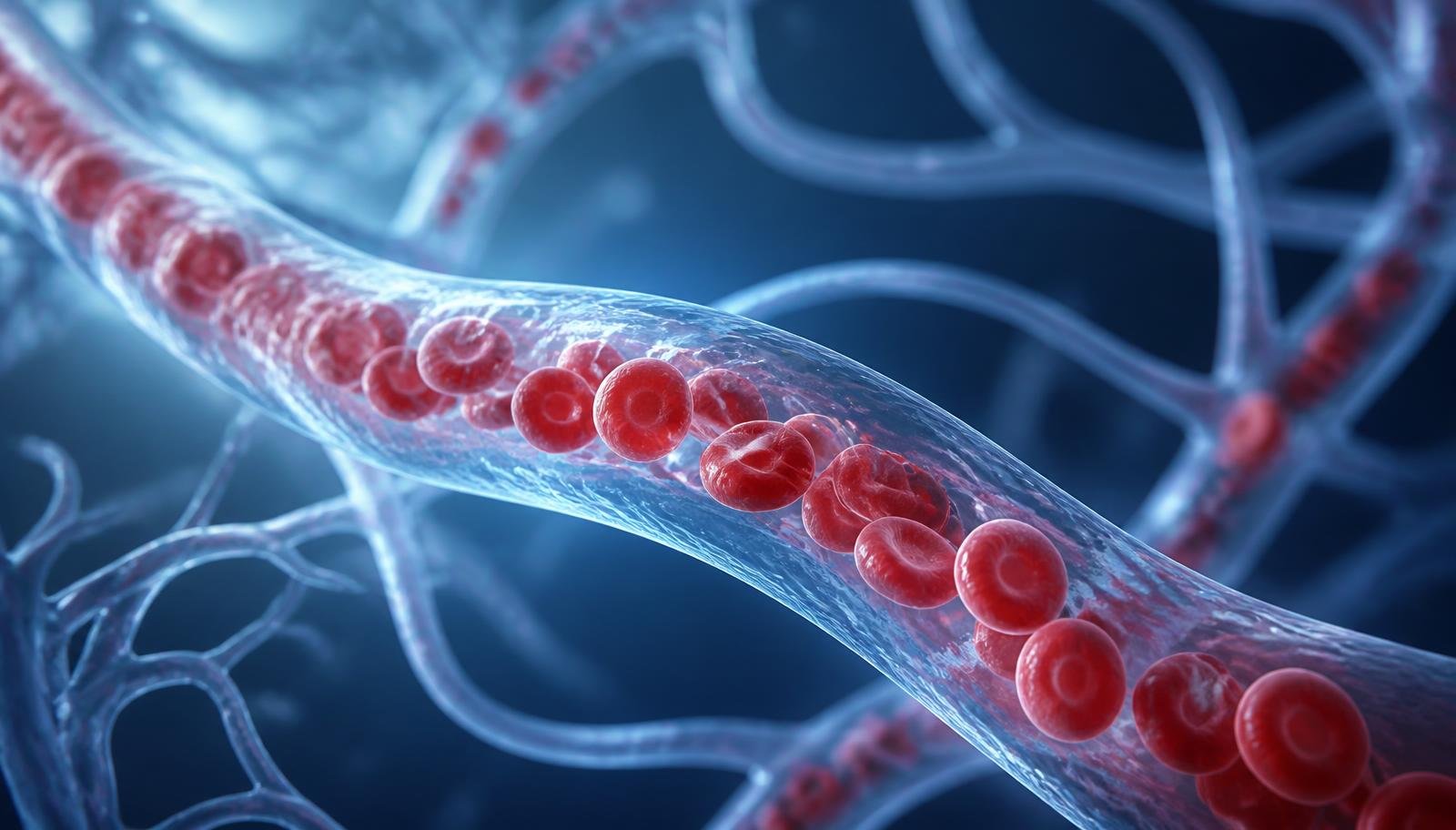
Abstract. Circulatory competence in men over forty is frequently discussed in terms of large-vessel health. A growing body of literature suggests that the more informative variable is microvascular perfusion, and that systemic acid–base status is a measurable modifier of it. This review summarizes the current understanding of nitric oxide signalling, vessel elasticity, and the laboratory-observed effects of simple alkaline compounds on circulatory regulation.
1. Introduction
The vascular system is commonly evaluated through the lens of its largest structures. Yet the aorta and major conduit arteries represent a minority of total endothelial surface area. The remainder resides in arterioles, capillaries and venules—vessels measured in micrometres and largely invisible to conventional imaging. It is within this microvascular compartment that oxygen exchange, nutrient delivery and thermoregulation actually occur.
Research summarized by Harvard Medical School’s Harvard Health Publishing describes the endothelium not as a passive lining but as an active endocrine organ, continuously adjusting vessel diameter in response to shear stress, oxygen tension and local chemistry. When that responsiveness declines, downstream tissues receive less perfusion at the same systemic blood pressure—a state that may remain clinically silent for years.
2. Nitric Oxide and Endothelial Signalling
Nitric oxide (NO) is the principal endogenous vasodilator. Synthesized from L-arginine by endothelial nitric oxide synthase (eNOS), NO diffuses into adjacent smooth muscle, raises cyclic GMP, and produces relaxation of the vessel wall. The 1998 Nobel Prize in Physiology or Medicine recognized this pathway as a foundational mechanism of cardiovascular regulation.
Reports from the National Institutes of Health, through the National Heart, Lung, and Blood Institute, indicate that NO bioavailability declines with age and with oxidative burden. The enzyme may remain present while its output is functionally reduced—a phenomenon described in the literature as eNOS uncoupling. The practical consequence is a narrower margin of vasodilatory reserve: the system can still meet resting demand, but responds more slowly to increased demand.
3. Vessel Elasticity as a Structural Variable
Elasticity is distinct from dilation. Where NO governs moment-to-moment tone, elasticity reflects the composition of the vessel wall itself—the ratio of elastin to collagen and the degree of cross-linking accumulated over decades. Pulse wave velocity, the standard non-invasive index of arterial stiffness, rises steadily from the fourth decade onward in most population cohorts.
Stiffer conduit vessels transmit pressure waves more forcefully into the periphery. The microvasculature, which is not constructed to buffer that load, responds with structural remodelling: wall thickening, lumen narrowing, and a measurable reduction in capillary density. Vitality, in the sense used across the geriatric literature—sustained energy, cognitive clarity, physical and sexual function—correlates more consistently with this peripheral capacity than with central blood pressure alone.
4. Systemic pH Balance and Circulatory Regulation
Human arterial pH is defended within an exceptionally narrow band, approximately 7.35 to 7.45, primarily by the bicarbonate buffer system. Carbon dioxide, carbonic acid and bicarbonate exist in equilibrium; the kidneys and lungs adjust that equilibrium continuously. This regulation is not merely defensive. Local pH is one of the direct inputs to vascular tone.
The Bohr effect describes how a modest drop in local pH shifts the oxygen–haemoglobin dissociation curve, releasing oxygen into working tissue. The corresponding vascular response—metabolic vasodilation—means that acid–base status and perfusion are mechanically coupled rather than merely correlated. Chronic low-grade metabolic acidosis, documented in the nephrology literature in association with advancing age and reduced renal reserve, therefore represents a plausible modifier of microvascular behaviour.
5. Alkaline Compounds Under Laboratory Conditions
Among the alkaline agents studied under controlled conditions, sodium bicarbonate (NaHCO₃) has the longest experimental record. It is a listed essential medicine, used clinically in the correction of metabolic acidosis, and has been examined for decades in exercise physiology as a buffering agent.
The mechanism reported in that literature is extracellular buffering: ingestion raises plasma bicarbonate concentration, which increases the gradient available for hydrogen ion efflux from working tissue. Hultman and Sahlin (1980) and, later, the systematic review by Carr and colleagues (2011) documented consistent shifts in blood pH and bicarbonate concentration following standardized dosing, alongside changes in the accumulation profile of metabolic byproducts.
It should be stated plainly that these findings describe biochemical and performance endpoints under laboratory supervision. They do not establish a therapeutic protocol for circulatory health, and sodium bicarbonate carries a meaningful sodium load with documented gastrointestinal effects at higher intakes. What the evidence does support is narrower and still notable: systemic buffering capacity is not a fixed constant, and it interacts with the same variables—local pH, oxygen offloading, vasodilatory response—that govern microvascular perfusion.
6. Discussion
Taken together, the three variables reviewed here—nitric oxide signalling, vessel elasticity, and acid–base regulation—are not independent. Oxidative stress reduces NO availability; reduced NO availability accelerates stiffening; stiffening increases peripheral load; and impaired buffering capacity alters the local chemistry in which all of this occurs. Interventions targeting a single node in isolation have historically produced modest and inconsistent results.
The methodological limitation across this field remains measurement. Microvascular function is assessed inconsistently between laboratories, and most large trials continue to use central haemodynamic endpoints as proxies. Until standardized peripheral assessment becomes routine, conclusions about long-term vitality should be treated as directional rather than definitive.
7. Conclusion
Long-term male vitality is better described as a perfusion problem than as a hormonal one. The evidence reviewed here supports continued investigation into the intersection of endothelial signalling and systemic pH regulation, with particular attention to the microvascular compartment. Readers are reminded that this article is a summary of published research and is not a substitute for individualized medical assessment.